Unpublished
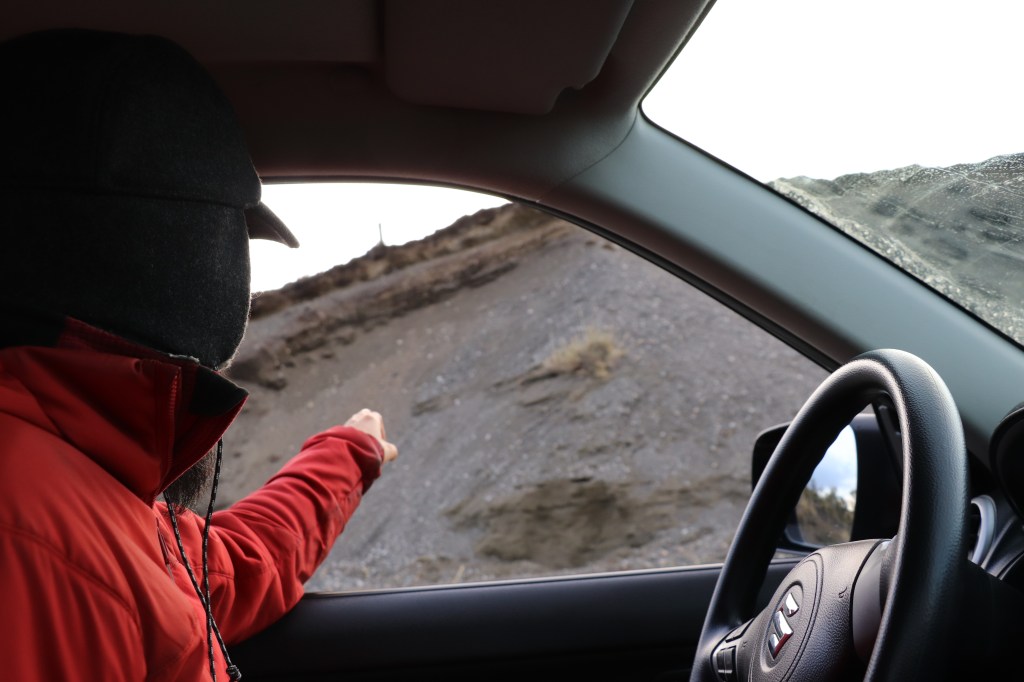
At the crest of a seemingly nondescript slope on the island of Tierra del Fuego, geomorphologist Rodrigo Soteres slams on the brakes of his rental SUV and abruptly reverses. Some stratification in the exposed hillside has caught his attention.
He rolls down his window and peers out. Then, he re-focuses his attention to an app on his phone, which he uses along with a pocket notebook to log his findings.
The grain of the sediment is finer toward the top layer, which to him looks “deformed,” Soteres says. The verdict from this land detective: This strata is evidence of an ancient pond that likely filled amid esker ridges, the result of sediment-heavy water gushing from beneath a glacier. As a geomorphologist, Soteres specializes in identifying these remnants of past ice ages and deducing where in Patagonia glaciers once stretched their lobe-shaped extremities.
“Outside Antarctica, we have the best-preserved and oldest glacial record, at least of the Southern Hemisphere,” says Soteres, a Ph.D. student at Pontifical Catholic University in Santiago.
This mapping work has brought us to the Tierra del Fuego steppe on a cool April afternoon. The winds whip through sturdy, yellow grasses that populate the hills here, and herds of guanacos roam wild under overcast skies. Aside from the occasional vehicle stirring up dust along these dirt highways, we haven’t seen another soul for hours.
But the glaciers have left their footprints. Understanding the ebb and flow of these icy masses in past millennia helps scientists identify climate-altering triggers that fill in clues about future climate and the pace of climate change accelerated by our fossil fuel emissions. As global temperatures rise, climate modelers are continually tweaking and refining their models to improve projections.
Tierra del Fuego presents Soteres with a unique opportunity for parsing past ice ages, as the island remains a remote retreat from human development and is well-preserved thanks to the cold, dry climate. The island, about twice the size of Vermont, has a population of less than 150,000.
“The emptiness is so vast, it’s impossible not to feel something,” says Soteres, 36, while we ferry there from a port across the Strait of Magellan.
And yet, I learn later, in many ways the landscape is not at all empty. Soteres reads the exposed hillsides, ridges and stray boulders and infers where lakes, rivers and glaciers once were. And while it’s a vastly austere landscape compared with the mountainous Andean region a few hundred kilometers north, it’s very beautiful.
Studying the Earth’s climate and geology over thousands and hundreds of thousands of years past presents a host of challenges, even with tools such as surface-exposure dating. In fact, there are glaring contradictions in prevailing theory.
In recent decades, scientists have concluded that during the last glacial period, ice sheets came and went at roughly the same time in both the Northern and Southern Hemispheres: Glaciers occupied the Chicago area at the same time they gripped Patagonia about 28,000 years ago, and remained until at least 17,000 years ago. Yet scientists also support a theory that seems to refute that.
Under Milankovitch theory, named for Serbian geophysicist Milutin Milanković, past climate fluctuations can ultimately be explained by changes in Earth’s axial tilt roughly every 40,000 years and changes in Earth’s orbit around the Sun every 100,000 years. But because of the tilt — which is also responsible for seasons — the resulting solar radiation cannot be evenly distributed around the planet, causing glaciers to form and retreat at the same time.
The question, then, is what variable caused the ice sheets to form and retreat at the same time 10,000 kilometers apart from each other.
“We’re still not really sure what all the linkages are in terms of what causes ice ages and the ends of ice ages,” explains Michael Kaplan, a paleoclimatologist at Columbia University.
There are varying theories, and one of them is a fluctuation in carbon dioxide and methane, greenhouse gases that can disperse evenly throughout the atmosphere over a geologically short period of time — less than 100 years, according to Kaplan. Another theory is that ocean currents altered the climate. It’s a giant, multidisciplinary puzzle, one of many facing paleoclimatologists and one in which Soteres plays a small but important part.
After geomorphologists like Soteres piece together detailed geological maps of an area, scientists can sample minerals, sediment cores or other material and assign a date to the birth of a glacial landform using cosmogenic dating. When cosmic rays traveling near light speed through the galaxy crash into rock, a chemical reaction generates an isotope that builds up over time. Measuring this build-up tells scientists when a glacier retreated, freeing the rock from its grasp. With these time estimations and geographic data, scientists can build out maps of where glaciers were, and when.
Soteres lives and breathes the hunt for ghost glaciers. If there is one glaring clue of their presence, it’s moraines: ridge-shaped masses of sediment and debris that are tossed aside by a glacier in retreat.
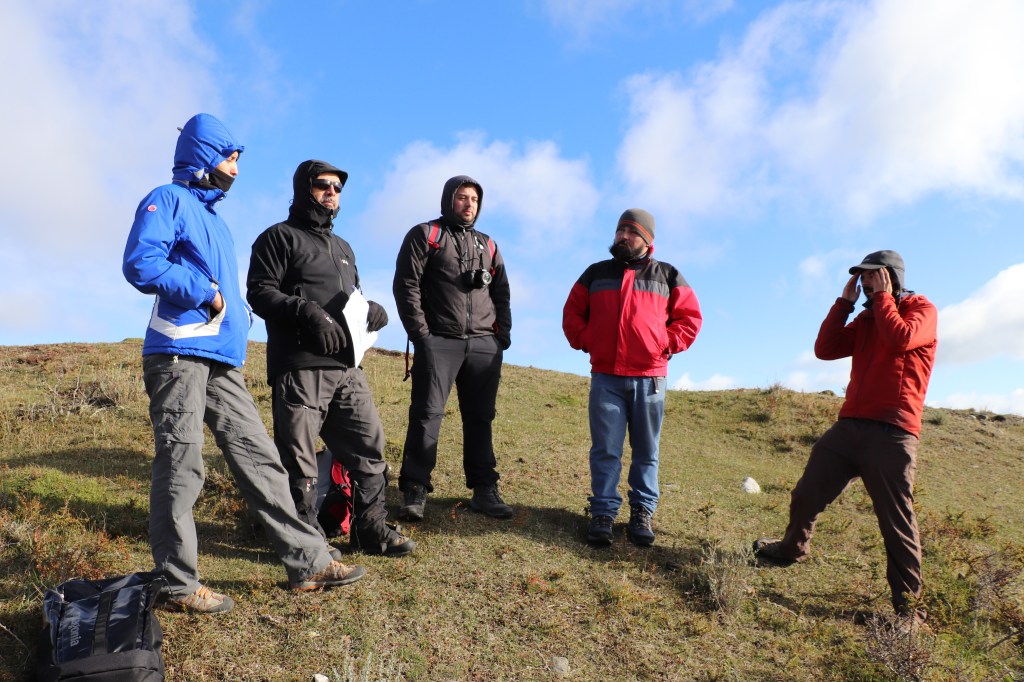
On a geological map, moraines are denoted by thin, slightly curved lines. They indicate where the Magellan ice lobe, for instance, was at various points over the course of its lifetime. Prevalent and easy to distinguish, moraines dominate conversation among Soteres and his colleagues. A devotee of his craft, he tells me over coffee that it can be hard to balance his vices: binge-watching movies, playing video games — “and finding moraines!”
The afternoon I shadow Soteres on his field work, he takes note of several moraines. At dinner, the discussion turns to moraines in the region and what they might mean for past glaciation. Amused at how frequently the landforms come up in conversation, well beyond the confines of the workday, I ask Soteres if he ever dreams of them. No, he tells me, but sometimes geological maps make an appearance.
Drumlins, elongated mounds that form beneath a moving glacier, also help to tell glaciers’ stories. With a distinctive shape, one rounded end that tapers in the direction in which the glacier was moving, drumlins are easy to spot from a distance. Viewed from above, they are oval in shape. And because they form in the direction in which the ice is moving, you might think of them as a glacier’s footprints.
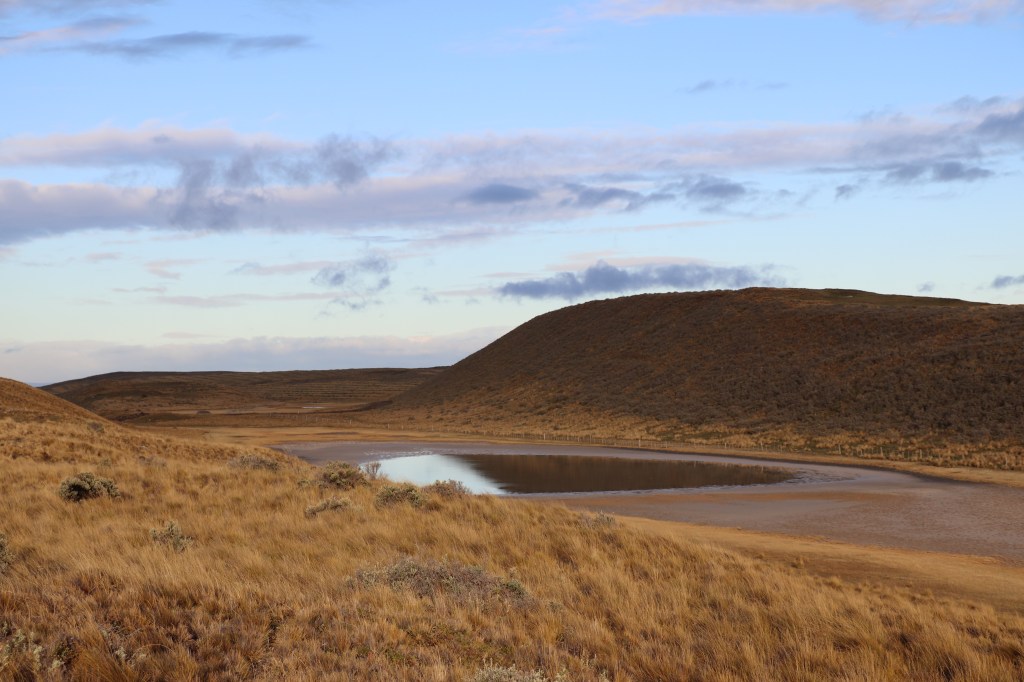
Thanks to landforms such as moraines and drumlins and cosmogenic, or isotopic, dating, scientists have a pretty good idea of where glaciers once extended in western Tierra del Fuego. But on this afternoon, Soteres has a side project of tracking a more elusive animal: an esker.
Eskers are ridgelike, but thinner and more jagged than the gentle slopes of a moraine or the tapering lobe of a drumlin. Eskers form beneath glaciers as fluid rushes out the back end, carrying then depositing sediment into piles. As the glacier changes direction, so, too, does the stream, creating tell-tale rugged configurations of sediment.
In Tierra del Fuego, eskers are rare. Soteres said that could be because the glaciers spanning southern Chile were drier than those in places like Europe, where eskers abound. They are also difficult to identify because they can be mistaken for moraines. So when Soteres spots a ridge from the roadside that he believes is an esker, he is positively giddy.
After stopping the car, he references notes in his phone and then peers out at the ridge in question. It has a sharper crest than that of a moraine, makes more abrupt changes in direction and the sediment appears distributed in distinct beds. His enthusiasm builds as he reaches his conclusion: It is, in fact, an elusive esker.
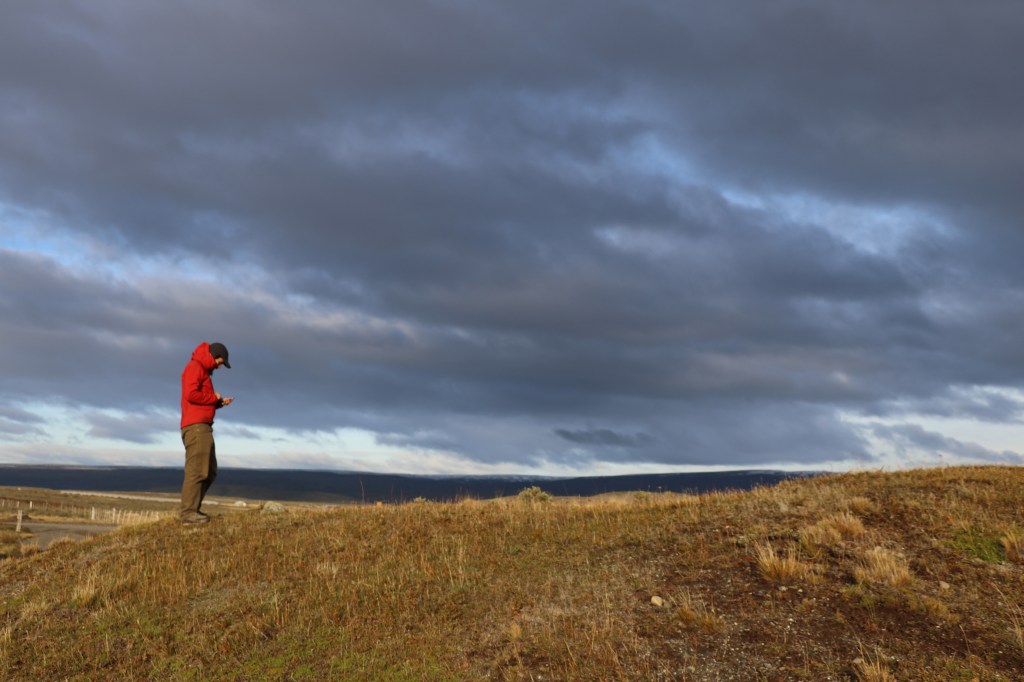
He bolts into the distance, 10, 20, 50 meters out. He stands beside the ridge and has a doctoral student along for the ride take his photo, for scale.
It’s a victorious moment, one Soteres couldn’t have hoped for without a keen eye for geomorphology and a tipoff from a February paper about possible eskers in northern Patagonia. He is all smiles.
“My first one!” Soteres exclaims as he climbs back into the car.
 lauren a. robinson, msj
Leave a comment